Tuesday, January 17, 2012

New Years in Ecuador: BOOM!

Imagine walking out your front door at midnight and seeing little fires burning all up and down the street and hearing firecracker explosions fill the night air *pop! pop! pop BOOM!* Here in Ecuador, New Year’s is a day of special and unique traditions. The most notable? Burning paper-maché figures or scarecrow like dolls stuffed with newspaper and firecrackers. Some people make them themselves. Others buy them from vendors downtown (prices range from $5-100 depending on size and quality). These “monigotes” or “viejos” go up in flames when the clock turns midnight. If the gasoline doesn’t make them burn quick enough, poppers are thrown in… POW! Fireworks boom in the sky. Kids and adults alike spin sparklers. Music blares from houses where guests will soon dance the whole night away. Other traditions? Wearing new red or yellow underwear for luck. Eating 12 grapes as the clock chimes twelve, also for luck. Eating lentils and/or filling a container with rice and keeping it in a special place to ensure you won’t go without food that year. Quite the list!

My New Year’s experience? We visited two different families. With the first, we danced out in the front yard and played with sparklers. With the second, we burned a “viejo” out in the street, threw firecrackers at the fire, ate our 12 grapes, sat down to a midnight meal of lentils, rice, and chicken, and conversed until 2am. It was a beautiful night and a blessing to share it with two wonderful families!

Pictures to come soon! :)

Saturday, December 31, 2011

December in Ecuador: The most wonderful and crazy time of the year!

Wow! Time has been whooshing by!! The last few months have been a whirlwind of activities and preparations for Christmas. Here's a little recap of some of our recent happenings:

Church celebrations: December was the month of Confirmations and 1st Communions in our parish! My housemate Katty proudly welcomed her RCIA students as full members of the church :) All the kids dressed up in gorgeous white dresses or shirt and tie for the special occasion. And afterwards- fiesta! Church moments are a reason to celebrate, and we were blessed to be invited to participate! One of the families had a big party with food and dancing into the night. I always tell Ecuadorians that when I have kids, I want to throw parties like that :)

Visiting Bucay: San Felipe had a Mass and candle-lit procession around the main streets in our neighborhood for the Feast of the Immaculate Conception. An adorned statue of the Virgin Mary led the way, with students and families following behind singing. And because students were out late, Madre Lucely cancelled school the next day :) I was invited to go visit a home in the country with all three Madres, one of the teachers from school, and a few relatives of the family that lives there. The finca (farm house) sat on rolling green hills covered in trees- right on the divide between the coast and mountain regions of Ecuador. It was absolutely beautiful! While there, the family welcomed us into their lives and made us feel at home. Some highlights of the trip: Milking a cow and drinking the fresh, boiled milk with hot cocoa powder. Exploring the gardens and seeing pineapple growing on the plant. Eating fresh sugar out of the cane. Hiking to a waterfall and swimming in the FREEZING cold pool! Spending time with a beautiful, generous Ecuadorian family.


Novenas y Posadas: The nine days leading up until Christmas were incredibly special here. At school, we had a novena each morning. The students acted out little parts of the Nativity story each day, sang religious Christmas carols, and participated in prayer. At night, each of the three chapels held their own prayer services or posadas. What is a posada you may ask? "Posada" means "inn" and is the beautiful tradition in some Spanish-speaking countries of acting out Mary and Joseph seeking shelter in Bethlehem. We went to a different house each night, following the two people dressed as Joseph and Mary and singing. Arriving at our destination, a singing exchange would take place until the doors of the house were opened and everyone entered to pray together. Even though peoples houses are small, the hospitality and love were tremendous. Being able to share in the anticipation of the Christ's coming with women, families, and the young people of our parish was a blessing. Their faith and dedication is an inspiration and a gift. One of the nights, the power went out and stayed out, so we held the whole event in candlelight.


Christmas: Feliz Navidad! On Christmas Eve, we all went to the three, yes THREE, Masses held in the parish. That's a lot of Mass in one night! But it was a chance to share and celebrate and be with our friends. At the first, I semi-directed the Nativity play, and it was a success! The most adorable part? One of the shepherds went running down the aisle of the church yelling, "The Christ was born! The Christ was born!". We definitely hadn't practiced it that way, and it was absolutely beautiful! We spent Christmas morning with kids from the youth group, revealing our "amigo secreto" and sharing some songs with a little fiesta for neighborhood kids that was going on. I am so thankful for the presence of such loving young people in our lives and for the role models they are in the community. That night, we visited Casa Damian, a hospital for Hansen's patients. We shared carols with the men and women who are alone during the holidays. Not having our families with us either, it was very special to share those moments together.

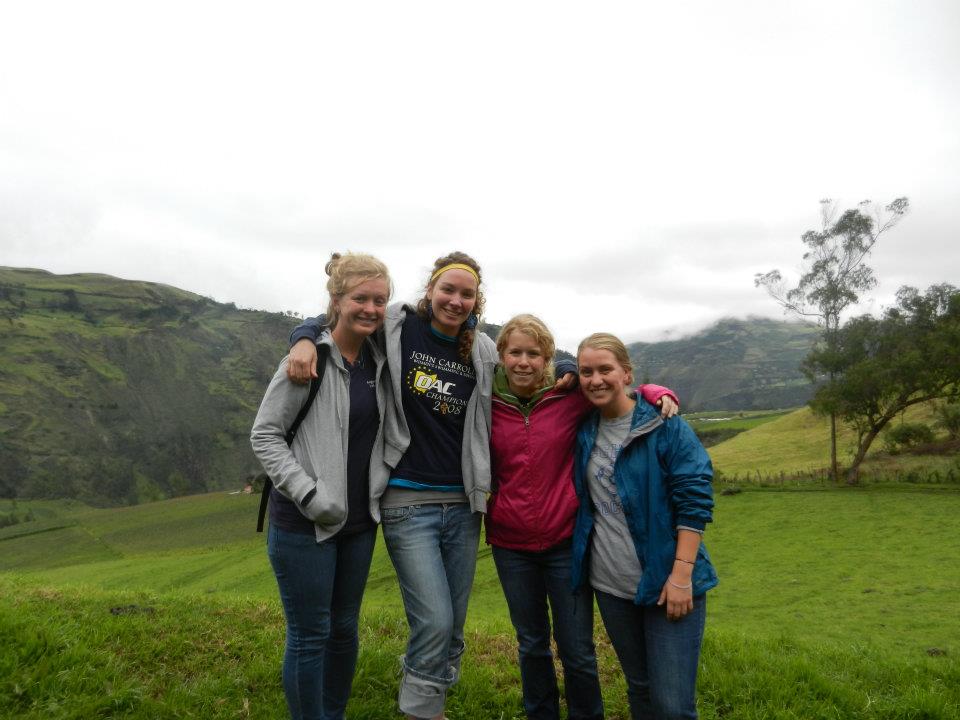
Riobamba: Vacation! Bernie, Katie, Lindsay, Liz and I took a trip to Riobamba after Christmas. We went seeking chillier weather in honor of the Christmas season :) Our adventures took us up Chimborazo, a snow-capped volcano, and to a little village called Candelaria where we hiked the rolling green hills. It's amazing and breath-taking how diverse the geography of Ecuador is. And while waking up at 5am to take a bus into the wilderness may not be the most relaxing way to vacation, it was absolutely worth it to experience the beauty of nature.

Wednesday, November 2, 2011

Exam Week at San Felipe

This week I am enjoying a week of VACATION! The reason? We just finished 2nd trimester exams. I was incredibly surprised to learn that in Ecuador, even elementary school kids take exams at the end of every grading period. An ENTIRE WEEK of tests! The oldest kids, who are only 8 years old, had 15 different subjects to study for. How stressful! Especially since the results make up 1/4th of the trimester grade. Even the little itty bitties took tests. I admit, I don't understand how effective it is to give five year old kids 10 different tests like that, but I did my best to be helpful during the process and to lend a hand when I wasn't proctoring my own English exams.

In one of the 1st grade classrooms, there is a boy with special needs. His name is Jesús. He can be a very loving or a very violent child, and this often changes without notice. When I have free time in my schedule, I work one on one with him, because left to his own devices, he does not accomplish much and spends a significant amount of time crawling around the floor on all fours barking. Imagine trying to help 20-some 5 year old kids (who can't read) take an exam while Jesús is pretending to be a puppy... yikes. So one of the test days, I worked on exams with him one-on-one. We were making some progress when all of a sudden, he looked at me with his eyes wide, exclaimed "oh no!", and slid out of his seat onto the floor. He then began crawling around making scary snake/dragon noises and pretending to bite other students' feet. Having worked with him many times before, I knew chasing him would not work. Picking him up and putting him back in his seat...also no. So I followed a few paces behind him saying, "Sea humano, por favor. Quiero hablar con el nino Jesús." (Be a human, please. I want to talk to Jesus the little boy.) Although my mind was absolutely frustrated, I kept my voice calm. And after what seemed like hours (which was only 3 minutes tops), he looked at me from the floor and shouted "Hola!". I made a big show of being overjoyed to find him human again, hugging him and thanking God. And we actually finished an entire exam!

A frustrating part of exams, I had a LOT of students try to cheat by writing things on their hands or by talking during the test. Ugg...very disappointing. But despite all that, most of my kids passed the exam, and some of them aced it!

Creepy Crawly Hatching Things

After three months of Ecuador life (which includes many meals eaten at neighbors' houses), I am proud to say that I have only caught one parasite (amoebas) and one stomach fungus! Exciting, yeah?? :) One of my community mates wasn't quite so lucky and currently has LICE. Yikes! I've spent many hours combing through her hair to pull out the little critters and tons of eggs. The worst part, you have to kill 'em...by squeezing them between your fingernails until they pop! Ah! But she should be clear soon! We're all going to get buggy things this year, though, so it's not a bug deal. Parasites and infections and critters will not defeat us! :)

Conveniently, there is a clinic within walking distance that can deliver test results in a day and write prescriptions to exterminate our little buggy friends. How much does it cost? For a medical consult, we pay $3. And for a parasite test? $2. Prescriptions are a little more expensive- it cost me $15 for three different medicines to get rid of the zoo in my belly. But even though it seems extremely cheap (we also have medical insurance that reimburses us), there are still many people who cannot afford the medical attention they need.

Something interesting related to health in Ecuador- there are a LOT of local remedies that we've been advised to try. When I came down with a cough, I was told to drink milk with garlic boiled in it (I wouldn't suggest it...although I did try it). A different friend fed me spoonfuls of fish oil (also not recommended). When my housemate was having trouble sleeping, we were told to blend pineapple and lettuce together and have her drink it (we never tried it). I was also told to leave a pineapple outside all night and then cut it up and feed it to her in the morning before she got out of bed...uh??? Not having a clue about medicine, I have no idea if there is any scientific backing to these methods, but who knows!

So what's it like in Monte Sinai, anyway?

I realized this week that I haven't actually described the neighborhood where I'm living this year. Ooops!

Monte Sinai and the surrounding communities were formally farm land. Settlement began when plots were sold cheaply and illegally to people seeking work opportunities closer to the city and to indigenous people who came from the mountains. Over the past 5 years, thousands upon thousands have come to call this place home.

Housing? Most of our neighbors live in cane houses. Many are built on stilts to avoid flooding during the rainy season. There are also a good number of cement block houses. These are seen as a status symbol and a major step up. Families save for years to start building a cement house, and even then it often takes years to complete. The insides of homes vary. I've only been in one house that did not have at least a couple of beds that people shared. Most have a fridge, an electric stove top (having an oven is less common), a TV, and plastic tables/ chairs. We know a few who have invested in computers, and one family that has a projector to watch movies on the wall.

Utilities? There is no running water in the community. The water people do have is not very clean and comes from "tanqueros" (trucks) that drive around during the day honking, filling up big plastic barrels outside peoples' homes. A refill costs $1. This seems cheap, but those living in the city pay far less for their water. Our volunteer house has a large cistern that pumps H2O and allows for showers and sinks, a luxury not available to our neighbors. Electricity is currently pirated and subject to frequent black outs. The longest we've gone without power is 10 hours (it actually went out Halloween night and stayed out until the morning-spooky!), but we've heard that in the past and during the rainy season it's been much worse and has stayed out for days at a time. This is terrible for businesses like restaurants, stores, and cyber cafes that rely on electricity to function (think refrigerators and food spoiling). There is a power plant close by which may soon start supplying energy to the neighborhoods. Families would have to pay, but it would mean a more stable and less dangerous connection.

Roads? Most roads are unpaved and in terrible condition. They turn to mud in the rainy season and make it difficult for cars and buses to pass (One really great thing is the public transportation- buses are frequent and only cost $.25!). There are a few main roads that are now paved and make travel much easier (especially for the great number of commuters who work in the city- a 2 hour bus ride away).

Overall, things are improving little by little it seems. There is more police presence. Garbage trucks enter the neighborhood twice a week (there was no trash pick-up previously, so people burned or threw garbage on the street). More businesses are cropping up too. At least two new internet cafes have opened within walking distance in the last few months. Progress.

However, there are many other issues that make life difficult. Drugs, alcohol, gangs, domestic violence, and machismo are very present in the community. Unemployment or unstable employment is also a major reality. Many of the men or fathers work in construction or other manual labor jobs that are unreliable and don't provide steady income. Discipline is mainly physical. Kids frequently talk about their parents hitting them.

But to end on a hopeful note, a non-profit called Hogar de Cristo is doing fabulous work in the community. One of their offices focuses on community organizing (my housemate Katie works there). There are currently groups of community members forming and growing, taking leadership roles and seeking ways to improve the quality of living here. This same non-profit also organizes women's groups (Bernadette works in this office) that meet to form relationships, talk about issues like family and self-esteem, and seek to empower women who are commonly confined to the home. There is also a group for senior citizen's rights that is working on giving attention and encouragement to the elderly in the area who often go forgotten. Good things are happening. People are working together for change.

Friday, October 14, 2011

San Feipe's 1st Ever "CASA ABIERTA"!

I know some of you are dying to see some of my students, so here are a few photos from the open house we had in September! It was a huge success with all the kids showing off projects they'd done :) They were so proud of themselves!!

 María, the 2nd grade teacher, with some of the kiddos!

Some of my 4th graders proudly showing off their "7 types of soil" project

Monday, October 10, 2011

A la finca!

After Mass a few Sundays ago, 5 of us traveled with our friends Victor, Damian, and Alejandra to the "campo" (the country) where Victor´s grandparents have a finca (farm). It was an absolute blessing to spend the afternoon chatting with the abuelitos and other family, eating delicious grilled plantains and menestra (a lentils and veggie dish), exploring the river, and swatting the ever persistant mosquitos :) All around us were plaintain, cacao, grapefruit, and papaya trees. The river was beautiful and peaceful. What a contrast to the city! Many thanks to Victor for inviting us and to his family for their generous hospitality.


Visiting with Victor´s grandparents, aunts, and cousins
 Us with Victor!

 Walking through the "wilderness" of plantain and fruit trees (and mosquitos!)